
Insights from Prof. Terzo Fondi, what the science supports, and a practical toolkit for bringing collagen into your dental clinic.
Collagen is the most abundant protein in the human body and a key structural component of the gums, alveolar bone, periodontal ligament and the organic matrix of dentin. Its production peaks around age 25 and begins to decline from about 30, while the enzymes that break it down (matrix metalloproteinases, or MMPs) become relatively more active. This matters for dentistry because periodontitis is largely a disease of collagen breakdown, so supporting collagen status is a logical complement to professional treatment, never a replacement for it. In implantology, collagen membranes and matrices are already well established, while oral hydrolyzed collagen is a newer, supportive area with promising but still limited dental-specific evidence. Clinics can introduce collagen through patient education, team training and a quality-controlled supplement offer, as long as they respect health-claim rules and always keep the treatment plan first.
A surgeon, painful hands and an unexpected discovery
Late in his career, around the age of 70, Prof. Terzo Fondi found himself unable to do the work he loved. Rheumatoid arthritis had made his hands so painful that performing surgical procedures became difficult. He handed his practice to his colleagues and retired, expecting to ride his motorbike as much as he wanted. Instead, the pain in his hands kept him off the bike.
By chance, he read a magazine article describing collagen as a supplement that could support joints affected by inflammation. He researched it thoroughly and began taking a hydrolyzed collagen product, still skeptical. Then one morning he and his partner, who had been taking it for back pain, woke up and realized the pain was gone.
“Ho cominciato a prenderlo con un po’ di scetticismo.”
Translation: “I started taking it with a bit of skepticism.”
That experience pushed him to study collagen seriously. He read everything available, including the few books published in Italian on the subject.
His story is anecdotal, and anecdotes are not clinical trials. But it raises a question every dental professional should ask: if one protein supports joints, skin, bone, ligaments and the tissues around the teeth, what does its decline mean for our patients’ mouths? This article collects the most relevant points from his talk, places them in the context of current dental science, and ends with a practical toolkit for clinics.
Watch the full talk with Prof. Terzo Fondi: click here . He was the guest of Be Health Global a leader in patented collagen nutraceuticals from Italy, Rome.
A surgeon, painful hands and an unexpected discovery
Late in his career, around the age of 70, Prof. Terzo Fondi found himself unable to do the work he loved. Rheumatoid arthritis had made his hands so painful that performing surgical procedures became difficult. He handed his practice to his colleagues and retired, expecting to ride his motorbike as much as he wanted. Instead, the pain in his hands kept him off the bike.
By chance, he read a magazine article describing collagen as a supplement that could support joints affected by inflammation. He researched it thoroughly and began taking a hydrolyzed collagen product, still skeptical. Then one morning he and his partner, who had been taking it for back pain, woke up and realized the pain was gone.
“Ho cominciato a prenderlo con un po’ di scetticismo.”
Translation: “I started taking it with a bit of skepticism.”
That experience pushed him to study collagen seriously. He read everything available, including the few books published in Italian on the subject.
His story is anecdotal, and anecdotes are not clinical trials. But it raises a question every dental professional should ask: if one protein supports joints, skin, bone, ligaments and the tissues around the teeth, what does its decline mean for our patients’ mouths? This article collects the most relevant points from his talk, places them in the context of current dental science, and ends with a practical toolkit for clinics.
What is collagen, exactly?
Collagen is a protein. That sounds obvious, but many people do not realize it. Proteins are the “noble” building blocks of the body, made of chains of amino acids. Collagen is the most abundant protein we have, making up roughly a third of total body protein.
“Il collagene è una proteina strutturale: rende tutti i nostri organi più forti e resistenti.”
Translation: “Collagen is a structural protein: it makes all our organs stronger and more resistant.”
Its architecture explains its strength. Amino acids, mainly glycine, proline and hydroxyproline, link into three chains that twist together into a triple helix. These helices assemble into fibers with remarkable tensile strength. That is why animal tendons, which are almost pure collagen, were once used for guitar strings and whips.
There are 28 recognized types of collagen, but four matter most:
- Type I is the most abundant. It is found in skin, hair, nails, bone, tendons and the periodontal tissues. It makes up about 90 percent of the collagen in skin.
- Type II is the main collagen of cartilage and joint cushioning, including intervertebral discs.
- Type III usually accompanies type I. It provides elasticity to skin and blood vessels and supports internal organs.
- Type IV forms the basement membrane, the thin layer that anchors tissues together, including the junction between epithelium and connective tissue.
There is almost no tissue in the body where collagen does not play a role. For a dental clinic, the key insight is that the mouth is a collagen-rich environment.
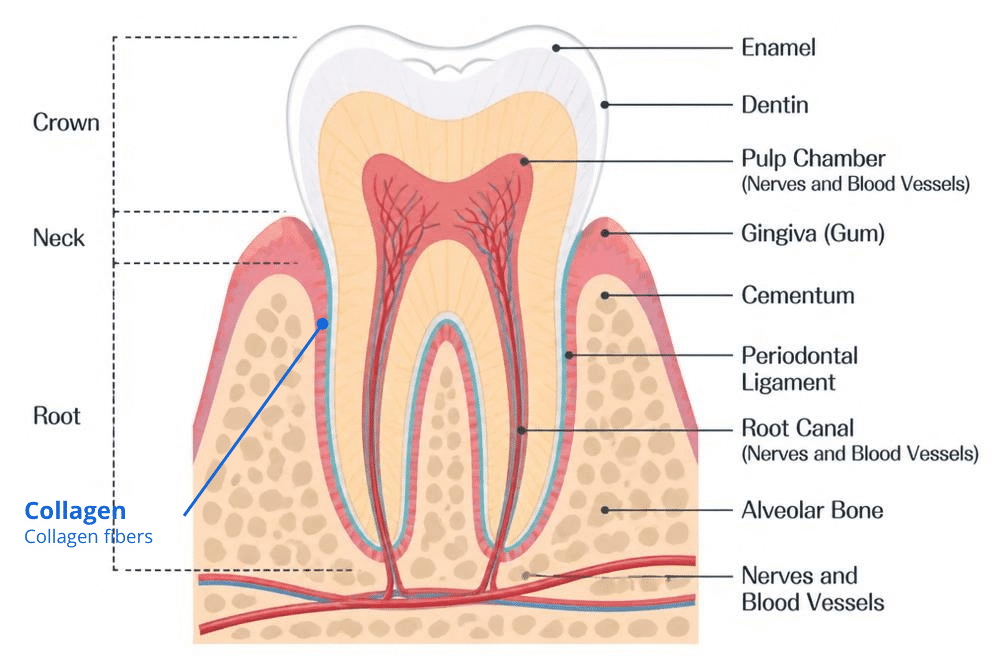
Collagen in the oral cavity: more than gums
Dentists know the anatomy, but the collagen lens is a powerful way to explain oral health to patients:
- Gingiva. The connective tissue of the gums is dominated by type I collagen fibers, which keep the gum firm and attached to the tooth.
- Periodontal ligament. The ligament that suspends the tooth in its socket is made largely of collagen fibers that absorb chewing forces.
- Alveolar bone. The organic matrix of bone is mostly type I collagen, on which minerals are deposited.
- Dentin. The organic part of dentin is also mainly type I collagen.
- Oral mucosa and wound healing. Every extraction, flap, graft and implant placement depends on new collagen being laid down during healing.
When a patient asks, “Why are my gums receding?”, “Why is my bone thinning?” or “Why is healing slower than before?”, collagen quality and quantity are part of the answer, alongside plaque control, genetics, smoking, systemic disease and mechanical factors.
Periodontitis: a collagen problem in disguise
“Si perdono più denti a causa delle parodontiti che non delle carie.”
Translation: “More teeth are lost because of periodontitis than because of cavities.”
Prof. Fondi describes the mechanism in a way patients understand immediately. The supporting tissues around the tooth gradually lose tone. Bacteria and plaque slip between the tooth and the supporting tissue. Because tissue cannot stay healthy in the presence of bacteria and the inflammation they trigger, it retreats, always seeking healthier ground. The tooth slowly begins to move. The gum tries to compensate by lengthening, but this makes things worse: a pocket forms where there is gum, but no real supporting tissue. The pocket cannot be cleaned properly, fills with bacteria and debris, and pus can eventually be expressed from it. That is the origin of the old name “pyorrhea”.
“In realtà la piorrea è solo un sintomo, è come se dicessi: ha la febbre.”
Translation: “In reality, pyorrhea is only a symptom, it is like saying: he has a fever.”
The question, he says, is to understand the causes, and one of the main ones is the lack of collagen, which relaxes the fibers that support the tooth.
This is consistent with the scientific literature. The destruction of periodontal connective tissue is driven largely by host enzymes called matrix metalloproteinases (MMPs), which degrade collagen in response to bacterial challenge and inflammation. In young, healthy tissue, collagen synthesis by fibroblasts and degradation by MMPs are in balance. In periodontal disease, degradation outruns repair.
The practical implication for your clinic: scaling, root planing, surgery and good hygiene remain the foundation. Nutritional and collagen-supportive strategies are best presented as a complement that helps create conditions for tissue repair.
Why collagen declines: the biology patients should understand
Many people believe collagen matters only for older adults. The biology says otherwise.
“25 anni è il massimo della produzione del collagene. Già a 30 anni comincia a degradare.”
Translation: “Twenty-five is the peak of collagen production. Already at 30 it begins to degrade.”
- Until about age 20, collagen production by fibroblasts and degradation by MMPs are in near-perfect balance.
- Production peaks around 25.
- From about 30, production slows while degradation continues or increases. Roughly 1 percent can be lost per year in the following decades, with visible signs between 40 and 50 and a marked reduction after 50.
- In women, the drop in estrogen at menopause accelerates the decline. Skin becomes drier, joint discomfort rises and bone density decreases.
Several factors speed up collagen breakdown, and they overlap with dental risk factors:
- Free radicals and oxidative stress from ultraviolet light, pollution, smoking and alcohol.
- Smoking, which both degrades collagen and is a major risk factor for periodontitis and implant failure.
- Poor nutrition, especially low intake of vitamin C, zinc, copper and protein.
This is useful patient messaging because it connects things you already tell them (stop smoking, eat well, control inflammation) to one clear biological story.
Collagen and implantology
Implantology is where collagen is already firmly established in clinical practice, though mostly in a different form than a supplement.
Collagen biomaterials. Resorbable collagen membranes are widely used in guided bone and tissue regeneration, and collagen matrices are used for soft tissue augmentation around teeth and implants. These products are supported by substantial clinical literature. Prof. Fondi also notes that surgeons historically used fibrin and fibrin glue, but collagen proved better because it does not only stop bleeding, it provides the scaffold on which new tissue is rebuilt.
Healing biology. Successful osseointegration and a stable soft tissue seal around an implant depend on well-organized collagen. Patients who heal poorly, such as smokers, older patients, patients with poorly controlled diabetes and postmenopausal women, are often patients with compromised collagen turnover.
Where supplements might fit. The idea that systemic collagen peptides could support healing and tissue quality is plausible and attractive, but we need to be precise. Clinical evidence for oral hydrolyzed collagen in periodontal and implant outcomes is still limited and evolving. For now, it is reasonable to describe it as a supportive nutritional adjunct, offered alongside, not instead of, evidence-based surgical and periodontal care.
How collagen supplements work: hydrolysis, peptides and cofactors
One of the most valuable points in the talk is a myth-buster. Patients sometimes think they can boil chicken bones or fish scraps and drink the broth to “take collagen”.
“Prendere del collagene così com’è non serve a niente. Per poterlo assumere, deve essere idrolizzato.”
Translation: “Taking collagen as it is is useless. To take it, it must be hydrolyzed.”
Native collagen is too large to be absorbed effectively. Hydrolyzed collagen is broken down into small peptides that are more digestible and bioavailable. According to the proposed mechanism, these peptides act as signals and building blocks that stimulate fibroblasts, the cells that produce collagen and elastin.
“Tu gli dai solo i mattoni per poterlo fare.”
Translation: “You only give it the bricks to be able to build it.”
Prof. Fondi also makes a point that is useful in the consulting room: patients cannot be “allergic to their own collagen”, because the body produces it. The more precise clinical statement is that supplements derived from fish or bovine sources can still trigger reactions in people allergic to those sources, so clinics should screen for fish and bovine allergies and read the label.
Quality is where products differ most:
- Source and traceability. Bovine, porcine or marine origin, with documented sourcing.
- Method of hydrolysis. Enzymatic hydrolysis is generally considered preferable to heat-based processing because it is selective and preserves peptide integrity.
- Purification and standardization. Filtration and a defined peptide profile.
- Clinical documentation. Branded peptides with published human studies are easier to defend than generic powders.
- Cofactors. Vitamin C is essential for collagen synthesis. Zinc, Copper and Silicon, and for bone-focused formulas Calcium and Vitamin D3, are often combined with collagen.
His advice to colleagues is simple:
“Quando consigliate del collagene, guardate sempre chi lo produce e come lo produce.”
Translation: “When you recommend collagen, always look at who produces it and how.”
He also notes that collagen types can be combined. Type I and III support skin, bone, tendons and muscle, while type II supports cartilage and joints, and they can be taken together as long as quality is high.
What the evidence supports, and what it does not
Credibility is the most valuable asset of a dental clinic. Any collagen program must be built on honest communication.
Reasonably well supported:
- Collagen is a major structural protein of periodontal tissues, bone and dentin.
- Periodontal tissue destruction involves collagen degradation by MMPs.
- Collagen membranes and matrices are established tools in regenerative dentistry.
- Vitamin C contributes to normal collagen formation for the normal function of bones, cartilage, gums, skin and teeth. This is an authorized health claim in the European Union.
- Hydrolyzed collagen peptides have been studied for skin and joint outcomes, with a number of positive randomized trials.
Plausible but still emerging:
- Oral collagen supplementation as an adjunct to periodontal therapy or implant healing. Early research is encouraging, but larger dental-specific trials are needed.
Not supported, and not to be claimed:
- That collagen cures periodontitis, rheumatoid arthritis, fibromyalgia or any other disease.
- That it replaces prescribed medication or professional treatment.
Prof. Fondi is clear on this himself:
“Bisogna sempre dire che non sostituisce le terapie mediche.”
Translation: “We must always say that it does not replace any medical therapies.”
He shares personal and colleague experiences in which people were able to reduce anti-inflammatory drugs, but these are individual stories. Patients who take medication for autoimmune or chronic conditions should never stop it without their physician’s advice.
Rules of the road: communicating legally and ethically
In the European Union, communication about supplements is governed by regulation on nutrition and health claims. In practice:
- Use only authorized claims (for example, vitamin C contributing to normal collagen formation for the normal function of gums, teeth, bones and cartilage). Avoid disease claims such as “treats”, “cures” or “prevents periodontitis”.
- Present supplements as part of a balanced diet and healthy lifestyle.
- Disclose any commercial interest transparently.
- Check local rules and your professional code of conduct on dentists recommending or selling products.
- Screen patients for allergies, pregnancy, breastfeeding, medication and chronic conditions, and refer to their physician when needed.
When in doubt, ask your regulatory or legal advisor before launching any patient-facing material.
Bringing collagen into your clinic: a practical toolkit, ideas which can work out for you
There is no single right way to do this. A solo implantologist, a family practice and a multi-chair clinic will each use collagen differently. Think of what follows as a menu of building blocks. Choose the ones that fit your patients, your team and your style, and start with two or three. The principle behind all of them is the same: educate first, support second, sell last.
1. Start with a clear clinic philosophy
Before any product or poster, decide how your clinic talks about tissue health. One sentence that the whole team can repeat is enough, for example:
“Healthy gums and good healing start with the structure of your tissues. We treat from the outside and support from the inside.”
This frames collagen as part of care, not as a side business, and gives every later action a consistent voice. A mission which is pararell with your clinic.
2. Make your team the engine
Patients trust the people who treat them. A collagen program works when the whole team can explain it in simple words. It’s very important. No medical terms.
- Hold a short internal training: what collagen is, its role in gums, bone and healing, what can and cannot be claimed, and which patients need extra caution.
- Give each role a clear part. The hygienist opens the conversation during cleanings. The dentist or implantologist confirms it in the treatment plan. The treatment coordinator explains the options and answers practical questions. The receptionist hands out the leaflet and manages follow-up.
- Share a one-page script and a short list of frequently asked questions, so answers are consistent.
- Revisit it every few months with real patient questions.
3. Build it into the patient journey
The best collagen programs do not feel like a campaign. They appear naturally at moments when the patient is already thinking about their tissues.
- Hygiene and periodontal maintenance. When explaining recession, bleeding or loss of firmness, the hygienist introduces collagen as one of the structural factors, together with technique and diet.
- Implant consultation. Add a “healing optimization” step next to smoking cessation, glycemic control and nutrition. Collagen sits comfortably in that conversation.
- Pre-operative preparation. Include a nutrition checklist covering protein, vitamin C and zinc, and mention the supplement as an optional extra.
- Post-operative care. Add a short note with recovery nutrition tips to the usual instructions.
- Bone grafting and sinus lift patients. These patients are already invested in tissue regeneration and are often receptive to supportive measures.
- Patients over 40 and postmenopausal women. Hormonal change affects skin, joints and bone density, and many patients already ask about collagen.
- Smokers and athletes. Two very different groups with a shared interest in recovery and resilience.
- Meetings dedicating to trying it with a proper explanation or demonstration
4. Create simple care programs
Packaging your advice into named programs makes it easier for patients to say “yes” and for the team to explain it. A few ideas:
- Gum Support Program: periodontal maintenance, personalized hygiene instruction, nutrition guidance and an optional collagen starter pack.
- Implant Healing Pack: a take-home kit with post-operative instructions, a nutrition sheet and the supplement, handed over at the surgical appointment.
- Healthy Smile After 40: a check-up focused on gum health, bone and hormonal changes, with an educational leaflet.
- Recall Plus: a small educational extra added to routine recall visits, such as a tissue-health mini-consultation.
Keep pricing transparent and offer the program as an option, never as an obligation.
5. Create a visible but calm presence in the clinic
- A small, tidy wellness corner in the waiting room with the products, ingredient sheets and leaflets.
- A poster or screen loop with three or four simple facts about collagen and healing.
- Chairside cards the hygienist can hand to the patient, with a QR code linking to this article or to the video with Prof. Fondi.
- A take-home starter kit that patients can pick up at reception.
- A short intake question on the medical history form about fish and bovine allergies, which also signals that you take safety seriously.
6. Educate with simple, shareable materials
- A one-page leaflet: “What is collagen and why does it matter for my gums and bones?”
- A myth versus fact card (boiling bones, supermarket powders, “I can’t be allergic”).
- A three-message WhatsApp or email sequence after a visit: a day-after tip, a week-after explanation and a one-month check-in.
- Short chairside sketches drawn by the dentist, filmed and shared as 30-second videos.
- A nutrition sheet for healing: protein sources, vitamin C foods, zinc and hydration.
- Professional Academy for Professionals: to spread out the significance of collagen, nutraceuticals in dentistry.
7. Make your website and content easy to find, for people and for AI (SEO, GEO and AEO)
Search engines and AI assistants favor clear, structured, trustworthy answers.
- Publish this article, or an adapted version, on your clinic’s blog, with the video embedded once the link is available.
- Add a dedicated page such as “Tissue health and healing” with a short FAQ.
- Use the question-and-answer format from this article and mark it up with FAQ schema.
- Add the name and credentials of the clinical author or reviewer, and cite the sources used.
- Post updates on your Google Business profile and share short educational clips on social channels.
Content ideas that work well:
- “What is collagen and why do your gums need it?”
- “Why healing slows with age, and what you can do about it”
- “Why periodontitis is not just about plaque”
- “Implant success: the role of tissue quality”
- “A day of eating for better healing”
- “Menopause, bone and gums: what changes”
- “Behind the scenes: how we choose products for our patients”
- “Patient question of the week”
8. Use events and community
- A patient evening, “Gums, bone and healing: what your tissues are made of”, with a short talk, a Q&A and a tasting of collagen-friendly foods.
- A webinar or live session on social media, ideally with a guest such as a nutritionist or pharmacist.
- Local partnerships with physiotherapists, gynecologists, nutritionists, pharmacists, gyms and sports clubs, who all meet patients with collagen-related concerns. Exchange educational material and referrals.
- A colleague evening for other dental professionals, using the talk by Prof. Fondi or any proffessional from your clinic as a starting point.
- A referral gesture, such as a complimentary hygiene check for a friend who attends the patient evening.
9. Choose your supplier and product carefully
Your name is on the recommendation, so quality matters more than margin. Ask any supplier for:
- origin and traceability of the raw material
- the hydrolysis method and the purification process
- certificates of analysis and allergen information
- published clinical studies on the specific peptides, not only on collagen in general
- the full formulation, including cofactors such as vitamin C, zinc, calcium and vitamin D3
- compliance documentation for your country
- training support, patient leaflets and a contact person for questions
Working with Be Health you are guaranteed of the highest quality premium products with over 30 years of science-backed experience in a health sector.
10. Keep ethics and safety at the center
- Always put the treatment plan first and the supplement second.
- Never use disease claims or promise results.
- Ask about allergies, pregnancy, breastfeeding and medication, and refer to the patient’s physician when needed.
- Share testimonials only with written consent and without implying treatment of a disease.
- Be transparent about any commercial relationship.
Ready-to-use tools
Intake question (add to the medical history form):
“Do you have allergies or intolerances to fish or bovine products? Are you pregnant or breastfeeding? Are you taking any regular medication?”
30-second chairside script:
“Your gums and the bone that holds your teeth are built on a protein called collagen. After about 30, the body produces less of it, and certain factors such as smoking and inflammation break it down faster. Good hygiene and treatment are the foundation. Some patients also choose a high-quality collagen supplement together with vitamin C as nutritional support. If you’d like, I can explain how to choose a good one.”
Follow-up message after a visit:
“Thank you for visiting us today. As promised, here is the short guide on supporting your gums and healing through nutrition. If you have any questions, just reply to this message. Remember that supplements never replace the treatment plan we agreed on.”
Social post template:
“Did you know? Your gums, bone and the ligament that holds your teeth are built on collagen. After about 30, production slows down. What can you do? 1) Keep up daily hygiene and your recall visits. 2) Eat enough protein and vitamin C. 3) Ask us about the right nutritional support for you. Link to the full guide in bio.”
Leaflet outline: What collagen is – where it is in your mouth – why it declines – what helps – what a good supplement looks like – safety and who should ask first – how we can help.
How to start without overwhelming the clinic
Pick three building blocks and do them well.
- Team training and a one-page script
- A leaflet and a waiting-room corner
- A published blog article with the video and an FAQ
Add patient evenings, care programs and local partnerships once the first three feel natural. Collect questions from patients and the team, and refine your materials as you go.
Frequently asked questions
Can collagen improve gum health?
Collagen is a main structural component of gum tissue, and adequate protein, vitamin C and collagen-supportive nutrition contribute to normal gum function. Research on oral collagen supplements as a periodontal adjunct is still emerging, so they should complement professional care rather than replace it.
Is collagen useful before or after dental implant surgery?
Collagen biomaterials such as membranes and matrices are widely used in implant surgery. Oral supplements may serve as a supportive nutritional measure, but clinical evidence in implantology is still limited. Discuss it with your dentist or surgeon.
At what age should someone start thinking about collagen?
Collagen production peaks around age 25 and begins to decline from about 30, so adults in their thirties and beyond are the typical audience for prevention-oriented education.
Why does collagen need to be hydrolyzed?
Native collagen molecules are too large to be absorbed effectively. Hydrolysis breaks them into small peptides that are easier to digest and absorb.
Can people be allergic to collagen supplements?
The body produces its own collagen, but supplements derived from fish or bovine sources can cause reactions in people allergic to those sources. Always check the label and screen for allergies.
Can collagen replace periodontal treatment?
No. Periodontitis requires professional diagnosis and treatment. Collagen support is a complement at most.
How should a clinic choose a collagen supplement?
Look at who produces it and how: source, enzymatic hydrolysis, purification, clinical documentation of the peptides, cofactors and compliance with local regulation.
Conclusion: understanding collagen is the first step to lasting oral health
Collagen is the scaffold of the gums, the ligament, the bone and the dentin. Its decline begins earlier than most patients think, and the enzymes that degrade it are central to periodontal disease. For clinic owners, this creates a clear opportunity: a science-based conversation that improves patient understanding, reinforces compliance with hygiene and maintenance, and opens a responsible, quality-controlled complement to treatment.
Prof. Terzo Fondi puts it simply:
“Comprendere a fondo il collagene è il primo passo per un benessere duraturo.”
Translation: “Understanding collagen in depth is the first step toward lasting well-being.”
Quality, honesty and patient safety are what turn a trend into a trustworthy part of your practice.
Disclaimer: This article is for educational purposes only and does not replace professional medical or dental advice. Dietary supplements are not intended to diagnose, treat, cure or prevent any disease. Consult a qualified professional before starting any supplement, especially if you are pregnant, breastfeeding, allergic to fish or bovine products, or taking medication.